
Managing Time Off in Multi-Country Households: A Practical Guide
When two people live in the same house but work under different country's public holidays and PTO rules, vacation planning gets complicated. Here's how to manage it.
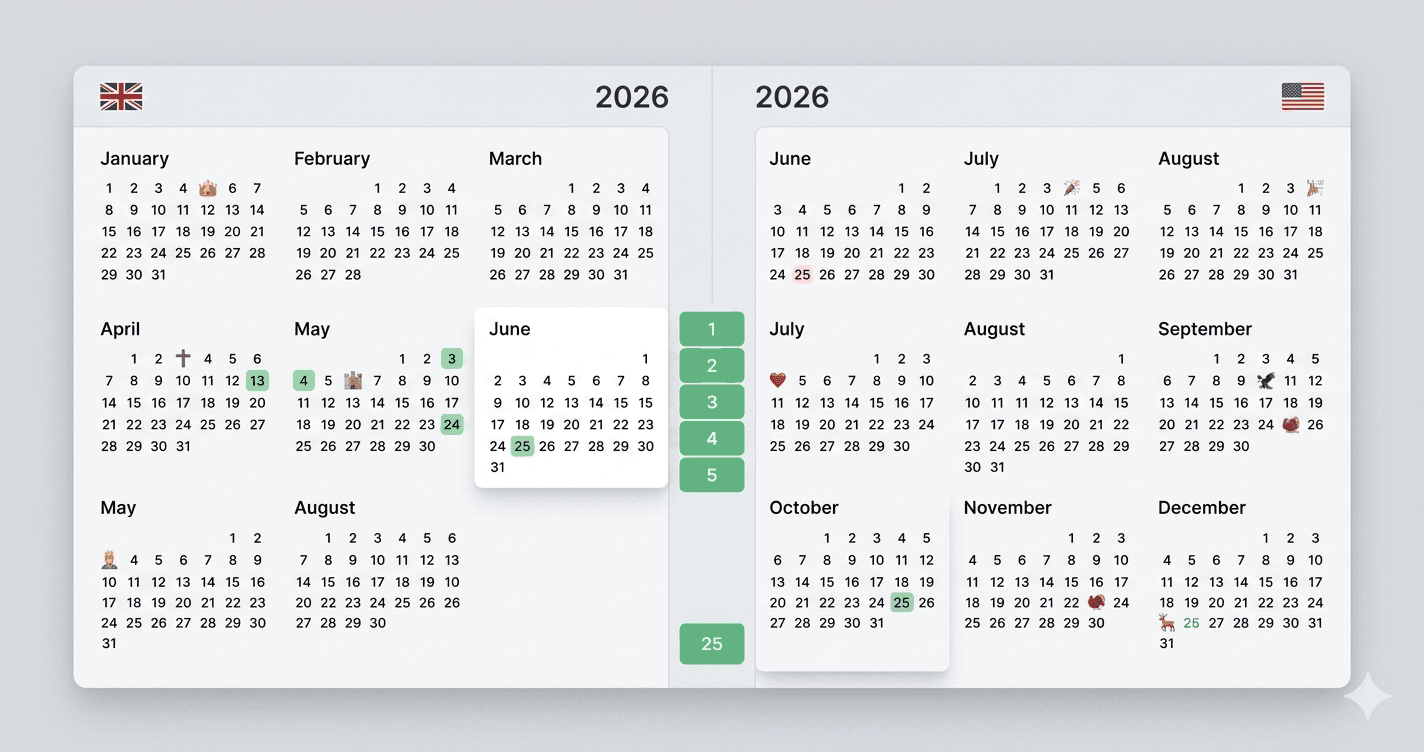
You share a home. You share a bed. But your public holiday calendars look nothing alike.
Multi-country households are more common than they used to be. Remote work has made it possible to live in one country while being employed by a company in another. International couples, expats, and cross-border commuters all face the same underlying problem: two people in the same household are operating on different calendars.
When your partner has a bank holiday in the UK on a Monday in May and you're sitting at your desk for an American employer who doesn't recognize it, the coordination problem becomes immediate and personal.
This guide covers the real challenges of managing time off across different country calendars, and practical approaches that actually work.
See Both Your Calendars in One Place
TimeOffCalendar supports 190+ countries. Each person sets their own holidays, and you see them together on one shared calendar. Free to start.
The Core Problem: You're Not on the Same Calendar
Public holiday systems vary enormously by country. Not just in which days are celebrated, but in how many there are, whether they're mandatory, and whether they're uniform across a country or vary by region.
| Country | National holidays per year | Regional variation? | Employer discretion? |
|---|---|---|---|
| United States | 10-11 federal | Yes (state holidays) | High (many employers don't follow all) |
| United Kingdom | 8 (England/Wales) | Yes (Scotland: 9, NI: 10) | Low (statutory) |
| Germany | 9-13 (state-dependent) | Yes (16 states) | Low |
| France | 11 | Minimal | Low |
| Australia | 8 national + state days | Yes (each state) | Low |
| Canada | 9 federal + provincial | Yes (provinces) | Moderate |
| Portugal | 13 | Minimal | Low |
| Netherlands | 11 | Minimal | Low |
A Portuguese employee has 13 guaranteed public holidays per year. A US employee might have 7 or 8 that their employer actually observes. A German employee in Bavaria has 13 state holidays; their colleague in Berlin has 9.
When two people from different parts of this table live together, there are immediate consequences:
- Days that one person has off, the other doesn't
- Long weekends that one person can take with 0 PTO days, the other has to use leave for
- End-of-year holiday windows where one person has a mandatory shutdown and the other doesn't
- Confusion about whether a given Monday is a holiday for "us" or just one of us
Real Scenarios Multi-Country Households Face
Scenario 1: UK employer + US employer
In the UK, the August Bank Holiday (last Monday in August) is a public holiday. In the US, there is no equivalent. A couple where one partner works for a British company and one for an American company will have one person off and one working on that Monday.
This happens at least 5-6 times per year, often with the holidays falling in ways that create asymmetric long weekends: one person gets a 3-day weekend automatically, the other has to decide whether to use a PTO day to match it.
Scenario 2: Remote worker employed abroad
An American living in Germany, employed by a US company, may not get German public holidays automatically. Their employer observes US federal holidays. Their partner, employed locally, gets German state holidays. The result: different rhythms entirely, even while living in the same city.
Scenario 3: Expat in a country with very different holiday counts
Moving from the US (8-10 observed employer holidays) to France (11 national holidays) or Portugal (13 national holidays) creates an immediate adjustment. The person on a local contract gets significantly more protected time off. The person still on a remote foreign contract has to actively manage the mismatch.
Scenario 4: Couples with school-age children
School holiday windows are determined by local education authority, not employer. Both parents need to take time off during school holidays regardless of which national holiday calendar their employer follows. This creates additional pressure on PTO that doesn't align with public holidays.
The Planning Challenges This Creates
Beyond the social friction of mismatched days off, multi-country households face specific planning challenges:
Finding shared free time is harder. The natural overlap windows, where both people are already off, are fewer. You can't assume a holiday weekend is a free weekend for both of you.
PTO use is asymmetric. One partner might use more PTO days to match the other's public holidays. Over a year, this can mean a significant imbalance in days used versus days "earned."
Travel planning requires more coordination. A trip that starts on a Friday public holiday for one person requires PTO from the other. Booking before checking both calendars is a reliable way to waste a day.
Year-end PTO pressure differs. If one person's leave year ends in December and the other's in March, use-it-or-lose-it pressure doesn't align. One person is scrambling to use days in November while the other is relaxed.
Practical Approaches That Work
1. Map both holiday calendars at the start of the year
The first step is visibility. Get both people's public holiday calendars for the year in front of you at the same time. Mark every public holiday for each person on a shared view.
This immediately reveals:
- Days where only one person has a holiday
- Days where both people have a holiday (your "free" shared days)
- Long weekend opportunities that require PTO from one person to share
Without this view, you're coordinating blindly.
2. Identify your highest-value shared opportunities
Look for windows where:
- Both people already have a public holiday (plan something without using PTO)
- One person has a public holiday adjacent to a weekend (use 1 PTO day to match it)
- A school holiday window overlaps with a holiday period for either parent
These are your high-value targets. Plan these first.
3. Budget the "matching" PTO explicitly
If your partner has 6 days off this year that you don't, and you want to spend those days together, you need to budget 6 PTO days specifically for matching. If you don't plan for this explicitly, it either doesn't happen, or it quietly drains your PTO without accounting for it.
Some couples approach this as a shared household budget: "We have X combined PTO days. We want to spend Y of them on shared time. Here's how we allocate them."
4. Use a tool that handles per-person holiday calendars
The practical bottleneck is usually visibility. Manually maintaining two holiday calendars and trying to spot overlaps is tedious enough that most people don't do it consistently.
TimeOffCalendar handles this natively. Each person sets their own country (and region where applicable). The shared calendar shows both people's public holidays, color-coded by person. Overlapping free days are highlighted automatically.
When planning a trip or a shared break, you open the calendar and immediately see: which days both of you are already off, which days require one of you to use PTO, and what the cheapest (in PTO terms) path to a shared break looks like.
5. Plan public holiday asymmetries explicitly
Rather than letting mismatched holidays create friction ad hoc, address them in advance. At the start of the year, go through the days where only one person has a holiday and decide: will the other person use a PTO day? Will they work from home? Will this be a normal workday for one and a rest day for the other?
Making these decisions in January, when there's no time pressure, is much lower-friction than making them the Thursday before a bank holiday weekend.
Country Pair Scenarios: Common Combinations
| Country combination | Typical mismatched holidays per year | Biggest friction points |
|---|---|---|
| US + UK | 10-12 | May Bank Holidays, UK August Bank Holiday, US Thanksgiving, July 4th |
| US + Germany | 12-15 | German regional holidays, US federal holidays, Christmas shutdown differences |
| UK + France | 6-8 | May holidays, Bastille Day, August Bank Holiday |
| UK + Portugal | 8-10 | Portuguese national days, UK Bank Holidays, different Easter timing |
| US + Australia | 10-14 | Australian state holidays, US federal holidays, inverted seasons |
| Germany + Netherlands | 3-5 | German state holidays without Dutch equivalent |
The more culturally different the two countries, the more mismatched holidays. US-European combinations tend to produce the most friction because the US has fewer nationally mandated public holidays than most European countries.
Managing School Holidays on Top of Everything Else
For households with children, school holidays add another layer. School terms are set locally, usually by regional education authorities, and they don't always align neatly with either parent's public holiday schedule.
The key principle here is to book school holiday coverage first, before optimizing for long weekends or bridging opportunities. Coverage during school holidays is a constraint, not a preference. Treat it as fixed, then plan around it.
In practice:
- Mark all school holiday windows in your shared calendar at the start of each school year
- Assign coverage responsibility per window (which parent is taking which week)
- Then look at what PTO remains for shared leisure time, and plan that second
Tools That Help
The fundamental requirement for multi-country household planning is a tool that shows both people's calendars, with their respective public holidays, in one view.
| Tool | Per-person country holidays? | Shared view? | PTO tracking? | Cost |
|---|---|---|---|---|
| TimeOffCalendar | Yes, 190+ countries | Yes, with overlap detection | Yes, automatic | Free (solo) / $5/mo (shared) |
| Google Calendar | Partial (one calendar per country) | Yes (overlay) | No | Free |
| Shared spreadsheet | Manual | Yes (manual) | Manual | Free |
| HR tools (BambooHR, etc.) | Company-level only | Team view only | Yes (employer-managed) | Enterprise pricing |
The Google Calendar approach works if you're disciplined about maintaining two separate holiday calendars and comfortable mentally reconciling the overlay. For most people, it's clunky enough that it doesn't get maintained consistently.
A purpose-built tool with per-person country settings and a shared view removes the manual overhead.
Frequently Asked Questions
We live in the same country but work for employers in different countries. Whose holidays apply?
Your public holidays are generally determined by your employer's country, not where you live, unless local law specifies otherwise. Check your employment contract and local labor regulations. In practice, most remote workers follow their employer's public holiday schedule.
Can we both use TimeOffCalendar even if we're in different countries?
Yes. Each person sets their own country (and region). The shared calendar shows both sets of public holidays, color-coded by person. This is one of the main use cases TimeOffCalendar was designed for.
What happens when we want to take the same week off but our public holidays don't align?
One person may need to use a PTO day to match the other's public holiday. Plan for this explicitly. Budget those PTO days at the start of the year so it doesn't catch you by surprise. The year-at-a-glance view makes these mismatches visible in advance.
Is there a "fairest" way to handle PTO when one person has more public holidays than the other?
Some couples treat total time off (public holidays plus PTO) as the relevant metric, not just PTO days. If one person has 13 public holidays and 20 PTO days (33 total) and the other has 8 public holidays and 25 PTO days (33 total), the totals balance even if the components differ. Others prefer to equalize PTO specifically. There's no universal right answer: it depends on what you're optimizing for.
Multi-country households have a more complex planning problem than single-country ones, but it's a solvable problem. The solution starts with visibility: getting both calendars in front of both people at the same time, with clear markers of which holidays belong to whom.
Finally See Both Your Calendars in One Place
TimeOffCalendar supports 190+ countries with per-person holiday settings. See your partner's holidays alongside yours. Free to start.
Related Articles
- Best 5 Vacation Trackers in 2026: Ranked and Reviewed
- TimeOffCalendar vs Google Calendar: Which Is Better for Tracking PTO?
- How to Maximize Your PTO in 2026: A Strategic Guide for US Workers
- How to Maximise Your Annual Leave in 2026: The Ultimate UK Guide
- Public Holidays Worldwide: A Country-by-Country Overview