
The Real Impact of Strategic Time Off Scheduling (it's not just about relaxation)
Strategic time off scheduling goes beyond rest. Research shows how planned vacations improve focus, reduce burnout, and make every PTO day worth more. Here's how to do it.
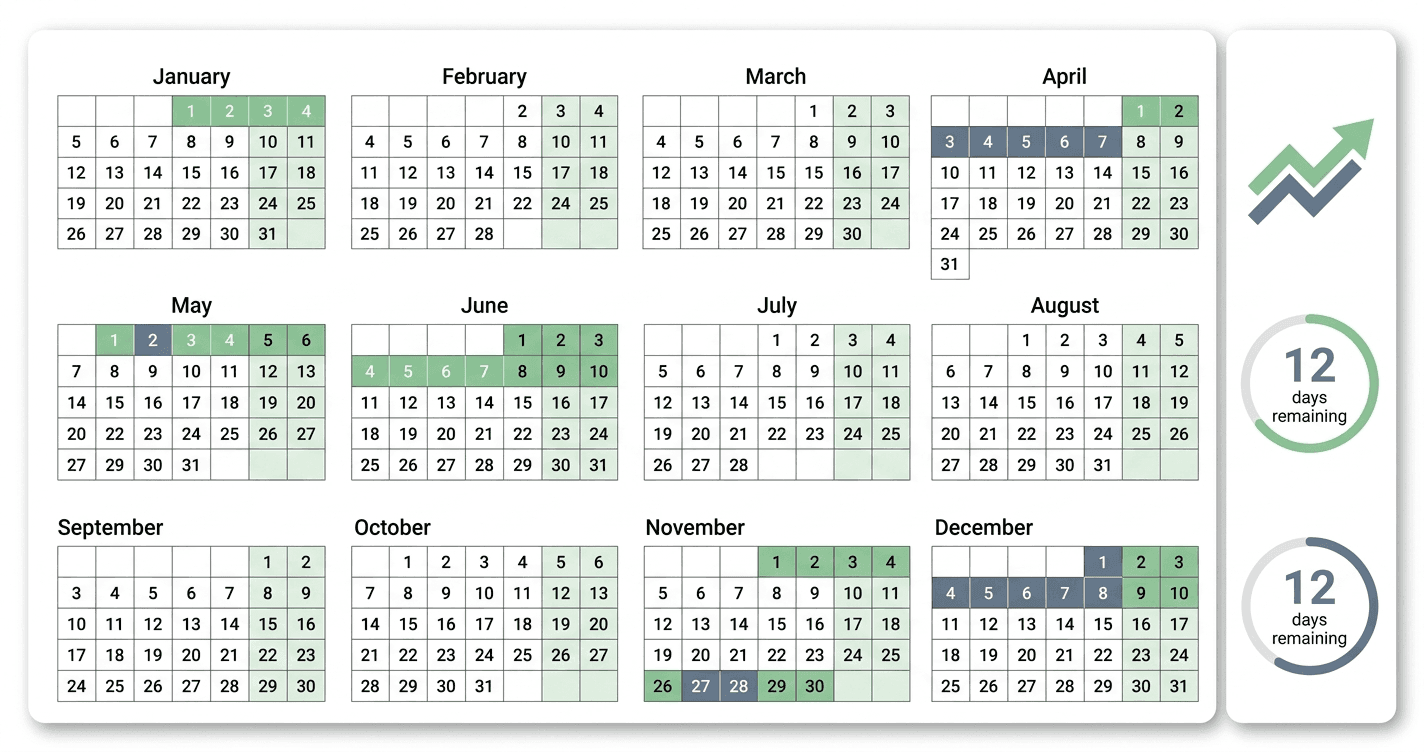
Most people think of vacation as the absence of work. A blank space on the calendar where nothing happens.
That framing misses most of the value.
Strategic time off scheduling is the practice of planning your days off in ways that maximize what you get from them: more rest, better recovery, longer breaks from fewer days, and fewer days wasted or lost at year-end. The difference between a reactive approach (booking time off when you have to) and a strategic one (planning when you should) is larger than most people expect.
Plan Your Time Off Strategically
TimeOffCalendar shows your whole year at once: public holidays, PTO balance, and potential long weekends. Free for individuals.
Why Unplanned PTO Underperforms
When time off is reactive, it tends to cluster in predictable ways:
- Rushed bookings around mandatory periods (Christmas, school holidays)
- Sick days and last-minute mental health days that don't count as "real" vacation
- A scramble in November and December to use remaining days before they expire
- Missed long weekends because nobody looked ahead far enough
The result: the same number of PTO days produces less actual rest. The breaks aren't long enough to fully disconnect. The timing is reactive rather than intentional. And a disproportionate amount of vacation happens under deadline pressure, which defeats the purpose.
What the Research Says About Vacation and Performance
The case for taking vacation isn't just personal: it's measurable.
Recovery and cognitive performance. Research consistently shows that sustained mental effort without adequate recovery degrades decision-making quality, creativity, and sustained attention. Vacation is one of the primary mechanisms for cognitive recovery. Short, frequent breaks produce different (generally better) recovery outcomes than one long annual leave taken all at once.
Burnout prevention. The leading predictors of burnout include sustained overwork without recovery periods. Regular, distributed time off is protective. One long vacation per year is not sufficient for sustained performance maintenance.
Spillover effects. How you feel on vacation affects how you perform after it. Vacations that are stressed, rushed, or poorly timed produce less recovery. This is a measurable phenomenon: the quality and timing of rest affects the return on rest.
The planning horizon matters. Anticipation of vacation has independent psychological benefits. People report higher wellbeing in the days leading up to a planned vacation, distinct from the vacation itself. Planning further ahead captures more of this benefit.
What Strategic Scheduling Actually Looks Like
Strategic time off scheduling is not complicated. It has three components:
1. Map the year before you plan anything
Look at the full calendar year at once. Mark every public holiday. Note weekends. Identify the natural bridging opportunities: places where a public holiday falls close enough to a weekend that a small number of PTO days can create a long break.
This is what a year-at-a-glance view is for. You cannot do this effectively with a month-by-month calendar. You need the whole year on one screen.
2. Identify your high-value opportunities
Not all PTO days are equal. Taking 2 days off when a public holiday falls mid-week can create a 5-day break. Taking the same 2 days at a random time in July creates 2 days off. The value per day taken varies enormously depending on placement.
High-value opportunities are typically:
- Public holidays that fall on Tuesday or Thursday (bridge Monday or Friday to create 4-5 day breaks)
- Clusters of public holidays within a 2-week window (bridge the gap between them)
- Shoulder periods around school and travel peak seasons (same quality of experience, cheaper, less crowded)
3. Distribute rest across the year
A single 2-week vacation in summer and nothing else is a common pattern. It's also suboptimal for recovery. Research on recovery patterns suggests that distributed rest across the year produces better sustained performance than concentrated rest.
A rough framework that many people find effective:
- One longer break (7-10 days) in summer or whenever your peak personal season is
- Two or three medium breaks (3-5 days each) distributed across spring, autumn, and winter
- Occasional single days used strategically around public holidays
This distributes recovery more evenly and avoids the long stretches without any break that precede burnout.
The Compounding Value of Long Weekends
Long weekends are systematically underused. They feel like small wins, but they compound.
| PTO days used | Days off gained | Break length | Efficiency (days off per PTO day) |
|---|---|---|---|
| 1 (Friday bridge) | 3 (Fri + Sat + Sun) | Long weekend | 3x |
| 1 (Monday bridge) | 3 (Sat + Sun + Mon) | Long weekend | 3x |
| 2 (bridge Tue holiday) | 5 (Sat-Wed or Mon-Fri) | Mini-break | 2.5x |
| 4 (bridge Thu holiday) | 9 (Sat-Sun) | Full week+ | 2.25x |
| 5 (standard week) | 7 (Mon-Sun) | Full week | 1.4x |
The most efficient use of PTO days is bridging a public holiday. A standard full week, with no holiday attached, is the least efficient use.
Most people know this intuitively. Few people actually plan for it, because it requires looking at the whole year at once and seeing where the opportunities are.
Common Scheduling Mistakes and How to Avoid Them
Mistake 1: Planning in isolation from your partner or household
If you and your partner have different PTO allocations and different public holiday schedules, coordinating independently creates conflicts. You discover in September that you booked the same week your partner has a work deadline, or that your company's shutdown overlaps with their busiest period.
Planning together, with visibility into each other's calendars and constraints, prevents this. It also surfaces opportunities: overlapping public holidays, shared school breaks, or windows when you're both naturally free.
Mistake 2: Waiting for the perfect week
The perfect week to take vacation usually doesn't exist. There will always be an upcoming deadline, a project in progress, or a reason to delay. Waiting for "when things calm down" is how people reach December with 10 unused days.
Plan the dates first. Let the work adapt around them. This is uncomfortable but effective.
Mistake 3: Ignoring small opportunities
A Tuesday public holiday that could become a 4-day break with one PTO day gets overlooked because "it's just one day." Multiply this by 3-4 opportunities per year, and you've left 12-16 extra days off on the table.
The year-at-a-glance view makes these visible. Without it, they're easy to miss.
Mistake 4: No year-end review
In January, most people don't know how many PTO days they lost in December. A year-end review of what you used, what you missed, and what patterns you want to change is one of the highest-value 30-minute planning sessions you can do.
Planning for Couples and Households
The scheduling complexity roughly doubles when two people are coordinating. Different employers, different public holiday schedules, different PTO entitlements, and shared family obligations create a planning puzzle that's hard to hold in your head.
The tools that help here are tools that show both people's calendars in one place, with per-person public holidays and PTO tracking. TimeOffCalendar is built for exactly this: a shared year view where each person's holidays and PTO show up color-coded, and overlapping free days are highlighted automatically.
| Planning element | Solo | Couple/household |
|---|---|---|
| Public holidays to track | 1 calendar | 2+ calendars, potentially different countries |
| PTO balances to monitor | 1 person | 2+ people |
| Overlaps to find | Not applicable | Critical for shared trips |
| School/family constraints | Optional | Often binding |
| Coordination required | Solo decision | Negotiation and visibility |
The solution isn't more complexity: it's better visibility. When both people can see the same year at once, the coordination becomes a conversation about preferences rather than a puzzle about logistics.
A Simple Year-Planning Framework
If you want to move from reactive to strategic, here's a concrete process:
In January (or whenever your leave year resets):
- Map your public holidays for the year
- Identify all bridging opportunities (score them: 1 PTO day for 4+ days off = high value)
- Block your highest-value opportunities first
- Add your planned longer breaks
- Leave a buffer (2-3 days) unplanned for sick days, emergencies, or opportunities that arise
If you share your calendar with a partner or family member, do steps 1-5 together, with visibility into both people's constraints.
Review quarterly. Check your balance. Look ahead to the next 90 days for anything you're missing.
Frequently Asked Questions
How far in advance should I plan my vacation?
For longer breaks, 3-6 months is ideal. It gives you time to coordinate with colleagues, book travel at better prices, and anticipate scheduling conflicts. For long weekends and short breaks, 4-6 weeks is usually sufficient.
What if my job doesn't allow much advance planning?
Even in unpredictable roles, there are usually some predictable windows: company slow periods, post-launch breathing room, holiday seasons. Start by anchoring to those. You can always move a planned day off: the risk of not planning is much higher than the risk of having to reschedule.
Is it worth planning long weekends, or should I save days for a longer trip?
Both have value, and they're not in competition. Long weekends provide more frequent recovery, which research shows is important for sustained performance. A longer trip provides deeper recovery and a more complete change of context. The optimal strategy for most people includes both.
How do I track my PTO balance and plan at the same time?
This is where a tool helps. TimeOffCalendar tracks your PTO balance automatically (mark a day off and the balance updates) and shows you the full year at once so you can plan strategically. The two tasks are integrated, not separate.
Time off is a resource. Like any resource, it can be spent intentionally or it can be wasted. The difference between the two is mostly planning, and planning mostly requires the right view of what's in front of you.
Stop Losing PTO Days Every Year
TimeOffCalendar shows your full year at a glance, tracks your balance automatically, and makes long weekend opportunities obvious. Free for individuals.
Related Articles
- Best 5 Vacation Trackers in 2026: Ranked and Reviewed
- TimeOffCalendar vs Google Calendar: Which Is Better for Tracking PTO?
- How to Maximize Your PTO in 2026: A Strategic Guide for US Workers
- How to Maximise Your Annual Leave in 2026: The Ultimate UK Guide
- Why a Specialized PTO Calendar Makes Travel Planning Easier