
Public Holidays Worldwide: A Country-by-Country Overview
How many public holidays does your country have? How does it compare to the rest of the world? A practical overview of public holiday counts, regional variation, and what it means for planning your time off.
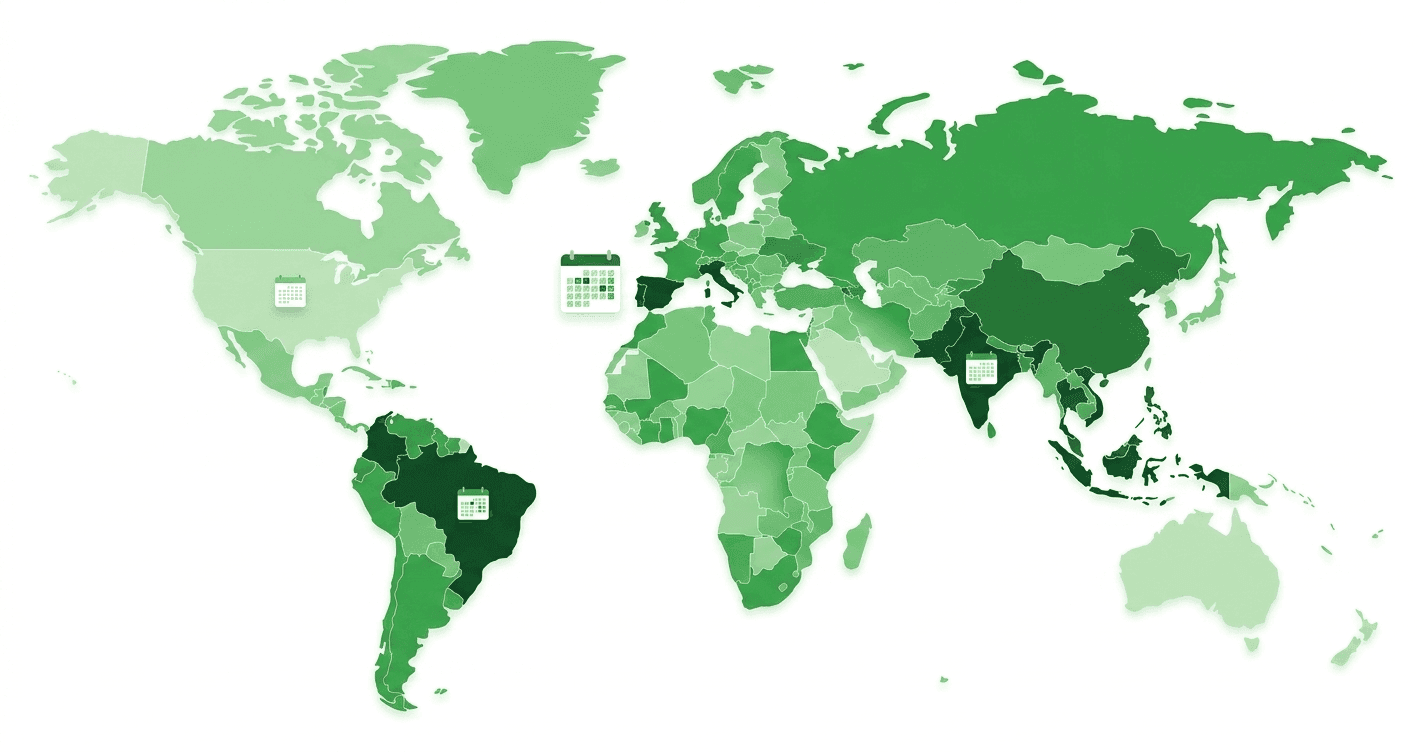
Not all public holidays are created equal.
A worker in Portugal gets 13 national holidays guaranteed by law. A worker in Mexico gets 7. A worker in the United States gets 11 federal holidays, but their employer may only observe 8 of them, and none of them are legally mandated. A worker in Germany gets anywhere from 9 to 13 depending on which state they live in.
If you work with people from different countries, live in a different country from where you work, or simply want to understand where your country sits in the global picture, this overview gives you the data.
Track Your Public Holidays Automatically
TimeOffCalendar supports 190+ countries. Set your country once and your public holidays load automatically. Free for individuals.
How to Read This Data
A few clarifications before the numbers:
National holidays vs. employer-observed holidays. Many countries have legally mandated public holidays, but employers are not always required to give all of them as paid days off. In the US, for example, federal holidays are only mandatory for federal employees. Private employers choose which to observe.
National vs. regional. Some countries have uniform public holidays across all regions. Others have a national base with regional additions. Germany, Australia, Canada, Spain, and the United States all have significant regional variation.
Calendar year. Counts below are approximate averages for 2026. Public holidays that fall on weekends may shift to Monday observance in some countries (adding or removing effective days depending on how you count).
Europe
| Country | National public holidays | Regional variation? | Notes |
|---|---|---|---|
| Portugal | 13 | Minimal | One of the highest counts in Europe |
| Spain | 8 national + regional | Yes, each autonomous community adds days | Total typically 12-14 with regional holidays |
| France | 11 | Minimal (Alsace-Moselle has 2 extra) | Consistent across most of mainland France |
| Italy | 12 | Some local patron saint days | Patron saint days vary by municipality |
| Germany | 9-13 | Yes, significantly by state | Bavaria has the most; Berlin among the fewest |
| Netherlands | 11 | Minimal | Includes King's Day (April 27) |
| Belgium | 10 | Minimal | Both national and community holidays |
| United Kingdom | 8 (England/Wales) | Yes: Scotland 9, Northern Ireland 10 | Bank holidays only; not all employers observe all |
| Ireland | 10 | Minimal | Includes St. Brigid's Day (February) |
| Sweden | 13 | Minimal | High count; includes Midsummer, All Saints' Day |
| Norway | 12 | Minimal | Includes Constitution Day (May 17) |
| Denmark | 11 | Minimal | Several Christian holidays included |
| Finland | 13 | Minimal | Includes Finnish Independence Day |
| Poland | 13 | Minimal | Several Catholic holidays |
| Austria | 13 | Minimal | High count, many Catholic observances |
| Switzerland | 8 federal + cantonal | Yes, significantly by canton | Total varies 9-15 depending on canton |
| Greece | 12 | Minimal | Orthodox Easter-based holidays vary by year |
Americas
| Country | National public holidays | Regional variation? | Notes |
|---|---|---|---|
| United States | 11 federal | Yes, state holidays | Private employers choose which to observe |
| Canada | 9 federal | Yes, significantly by province | Total typically 10-14 with provincial holidays |
| Mexico | 7 mandatory | Minimal | Low national count; regional customs vary |
| Brazil | 12 national | Yes, state and municipal additions | Total can exceed 15 with local holidays |
| Argentina | 19 | Minimal | One of the highest counts in the Americas |
| Colombia | 18 | Minimal | High count, many Catholic observances |
| Chile | 15 | Minimal | Includes several national commemoration days |
| Peru | 13 | Minimal | Mix of national and Catholic holidays |
Asia-Pacific
| Country | National public holidays | Regional variation? | Notes |
|---|---|---|---|
| Japan | 16 | Minimal | Among the highest counts globally |
| South Korea | 15 | Minimal | Includes Lunar New Year and Chuseok (multiple days) |
| China | 7 statutory + Golden Weeks | Minimal | Golden Weeks (Spring Festival, National Day) involve complex make-up day schedules |
| India | 3 national + state holidays | Yes, significantly by state | Total varies widely; some states have 20+ holidays |
| Australia | 8 national | Yes, significantly by state | Each state adds additional public holidays |
| New Zealand | 11 national | Yes, regional anniversaries | Each region observes its own anniversary day |
| Singapore | 11 | Minimal | Multi-cultural holidays: Chinese New Year, Deepavali, Hari Raya |
| Hong Kong | 17 | Minimal | High count; mix of Western and Chinese holidays |
| Philippines | 12 regular + special non-working days | Minimal national | Special non-working days add more flexibility |
Middle East and Africa
| Country | National public holidays | Regional variation? | Notes |
|---|---|---|---|
| UAE | ~14 | Minimal | Islamic holidays shift annually with lunar calendar |
| Saudi Arabia | ~14 | Minimal | Islamic holidays are primary; Gregorian dates shift each year |
| Israel | ~9 | Minimal | Jewish holidays observed; lunar calendar dates shift annually |
| South Africa | 12 | Minimal | Includes several post-apartheid national commemoration days |
| Nigeria | 12 | Minimal national | Mix of Christian, Islamic, and national holidays |
| Kenya | 11 | Minimal | Includes national days and Christian holidays |
Key Patterns and What They Mean for Planning
Countries with the most public holidays
Japan, Hong Kong, Argentina, Colombia, Austria, Portugal, Sweden, Finland, and Poland all sit at 12 or more national holidays. Workers in these countries have a meaningful head start in total time off before PTO is even considered.
Countries with the fewest
Mexico (7), the United States (11 federal, fewer observed), and the UK (8 for England and Wales) have relatively low national holiday counts compared to peers. Workers in these countries depend more heavily on their PTO allowance to build meaningful breaks.
Regional variation creates real complexity
Germany, Australia, Canada, Switzerland, Spain, and the US all have substantial regional variation. Subscribing to a national holiday calendar without specifying your region means you're working with an inaccurate picture. This matters especially for multi-country couples and remote workers.
Islamic calendar holidays shift annually
Countries that observe Islamic holidays (Eid, Ramadan, etc.) have public holidays that shift approximately 11 days earlier each Gregorian year. Planning around these requires checking actual dates for the specific year, not assuming consistency from previous years.
Why This Matters for Couples and Distributed Households
If you and your partner work in different countries, or for employers in different countries, the table above illustrates why a single shared holiday calendar doesn't work.
A couple where one person works for a UK employer (8 bank holidays) and the other for a Spanish employer (12-14 with regional days) will have a significantly different number of days off, on different dates, with minimal overlap on some weeks and coincidental overlap on others.
Planning shared trips and long weekends requires knowing both people's holiday schedules simultaneously, not just one of them.
TimeOffCalendar handles this by letting each person set their own country and region. Both sets of holidays appear on the shared calendar, color-coded by person. Days where both people already have a holiday are highlighted automatically: these are your highest-value shared opportunities, requiring no PTO from either person.
Looking Up Your Country
If your country isn't in the tables above, TimeOffCalendar supports 190+ countries. Set your location in your account and your public holidays load automatically for the current year, with correct dates including any Monday substitution rules for holidays that fall on weekends.
Frequently Asked Questions
Why do some countries have so many more public holidays than others?
The count reflects a mix of historical, religious, and political factors. Countries with strong Catholic traditions (Italy, Portugal, Spain, Poland, Austria) tend to have high counts from religious observances. Countries with recent political history to commemorate (South Africa, Colombia, Argentina) add national days. Countries with a more secular or employer-driven tradition (US, UK) tend to have lower statutory counts.
Do public holiday counts include weekends?
No. The counts above refer to designated public holidays that fall on weekdays. A holiday falling on Saturday or Sunday may or may not be substituted with a Monday, depending on the country's rules.
My employer doesn't give me all the national public holidays. Why?
In many countries, statutory public holidays are a floor, not a ceiling. Private employers are sometimes legally required to observe only a subset, or are required to observe all of them but can substitute equivalent days. Your employment contract or staff handbook will specify which public holidays your employer observes.
How do I find the exact dates for public holidays in my country?
TimeOffCalendar loads current-year public holidays automatically for your country and region. You can also check your national government's official website, which publishes the annual public holiday schedule.
Public holidays are part of your total time-off picture. Knowing how many your country provides, how they compare globally, and which ones apply specifically to your employment situation is the starting point for planning time off well.
Load Your Country's Holidays Automatically
TimeOffCalendar supports 190+ countries and regions. Set your location once and your holidays load automatically, every year. Free for individuals.
Related Articles
- Best 5 Vacation Trackers in 2026: Ranked and Reviewed
- TimeOffCalendar vs Google Calendar: Which Is Better for Tracking PTO?
- 5 Common Public Holiday Tracking Mistakes (And How to Avoid Them)
- How to Maximize Your PTO in 2026: A Strategic Guide for US Workers
- How to Maximise Your Annual Leave in 2026: The Ultimate UK Guide