
5 Common Public Holiday Tracking Mistakes (And How to Avoid Them)
Most people track public holidays incorrectly, or not at all. These five mistakes cost you days off every year. Here's how to fix them.
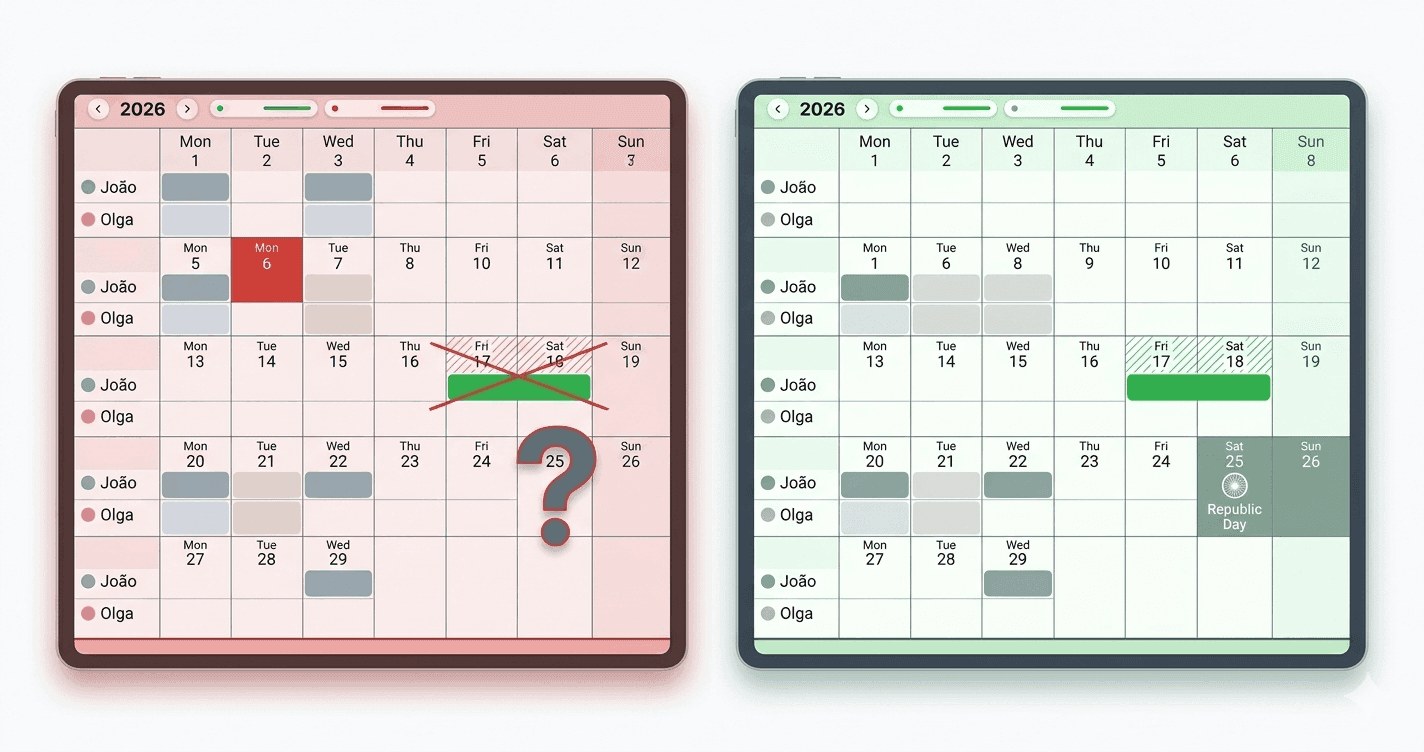
Public holidays are free days off. They don't cost you any PTO. And yet, most people manage to get less value from them than they should, year after year.
The mistakes aren't dramatic. They're small, consistent, and surprisingly common. You don't notice them in isolation. But across a year, they add up to missed long weekends, last-minute scrambles, and the vague feeling in December that you didn't quite make the most of your time off.
Here are the five most common public holiday tracking mistakes, and what to do instead.
Stop Missing Free Days Off
TimeOffCalendar loads your public holidays automatically and shows the whole year at once, so you never miss a bridging opportunity. Free to start.
Mistake 1: Relying on Memory Instead of a Loaded Calendar
The most common mistake is simply not having your public holidays visible in your planning calendar.
Most people know their country has public holidays. They know roughly when the big ones fall (Christmas, Easter, maybe a spring bank holiday). What they don't have is all of them, accurately dated for the current year, visible alongside their PTO days in one place.
The consequence: you discover a public holiday 3-4 days before it happens. At that point, it's too late to plan a trip, coordinate with a partner, or book anything at a reasonable price. The holiday becomes a day off with no plan rather than an opportunity you prepared for.
What to do instead: Load your public holidays into your calendar at the start of each year. Don't enter them manually (you'll miss some and get dates wrong). Use a tool that loads them automatically for your country. TimeOffCalendar does this for 190+ countries and regions, per person, so each person's holidays reflect their actual employer's calendar rather than a generic national list.
Mistake 2: Using the Wrong Country's Holidays
This mistake is more common than it sounds, and it's growing more common as remote work spreads.
If you work remotely for a company in a different country, your public holidays are typically determined by your employer's country, not where you live. An American working remotely for a British company observes UK bank holidays, not US federal holidays. A Portuguese national working for a German employer observes German public holidays.
Many people subscribe to their country of residence's public holiday calendar out of habit, or because it's the default in their calendar app. If their employment situation doesn't match, they're tracking the wrong holidays: counting days off they don't have, or missing days off they do.
What to do instead: Confirm which country's public holidays apply to your employment contract. Check with your employer if you're unsure. Set your calendar to the correct country, which may not be where you live. If you and your partner are in different situations, each of you should have your own correctly configured holiday calendar.
Mistake 3: Not Accounting for Regional Variation
Many countries don't have uniform public holidays across all regions. The variation can be significant.
| Country | Example of regional variation | Difference in holiday count |
|---|---|---|
| Germany | Bavaria has Epiphany (Jan 6), Berlin does not | Up to 4 extra days in some states |
| United States | Some states observe Columbus Day, others don't | 1-2 days |
| United Kingdom | Scotland has St Andrew's Day; England/Wales do not | 1-2 days |
| Australia | Each state has different additional public holidays | 2-4 days |
| Canada | Provincial holidays vary significantly by province | 2-5 days |
| Spain | Regional autonomous communities add their own days | 1-3 days |
Subscribing to a national holiday calendar without specifying your region means you may be missing holidays you're entitled to, or including holidays that don't apply to you.
What to do instead: Use a tool or calendar that supports regional holiday configurations, not just country-level. Set your specific state, province, or region, not just the country.
Mistake 4: Missing the Bridging Opportunities
This is the most expensive mistake in terms of lost value, and it's almost entirely a visibility problem.
A public holiday that falls on a Tuesday or Thursday creates a natural bridging opportunity: one additional PTO day turns it into a 4-day weekend. Two holidays in the same week, with a few PTO days, can create a 9-day break.
Most people know this in theory. In practice, they don't spot these opportunities in time to act on them. By the time they notice that a Thursday holiday is coming up, it's 2 weeks away, flights are expensive, and their partner has already committed to something else.
The reason is almost always a visibility problem. You can't see the opportunity if you're looking at a month-by-month calendar. You need the full year in front of you to see where the clusters are and which ones are worth planning around.
| Holiday day | PTO days needed | Total days off | Opportunity value |
|---|---|---|---|
| Monday | 0 (already a long weekend) | 3 | Low (already free) |
| Tuesday | 1 (bridge Monday) | 4 | High (4 days for 1) |
| Wednesday | 2 (bridge Mon + Tue or Thu + Fri) | 5 | Medium (5 for 2) |
| Thursday | 1 (bridge Friday) | 4 | High (4 days for 1) |
| Friday | 0 (already a long weekend) | 3 | Low (already free) |
What to do instead: Look at the full year in January. Identify every bridging opportunity. Score them by value (days off gained per PTO day used). Book the highest-value ones first, before travel prices rise and partner calendars fill up.
Mistake 5: Not Accounting for Your Partner's Different Holidays
If you and your partner work for different employers, particularly in different countries, you may have significantly different public holiday schedules. Treating one person's holidays as "our holidays" leads to predictable problems:
- You assume a Monday bank holiday is a shared long weekend. Your partner works that day.
- You book a trip around a holiday your partner doesn't have, requiring them to use PTO.
- You miss shared opportunities where both of you have holidays at the same time.
The underlying issue is that most households manage time off with a single shared calendar, which can't represent two different people's public holiday schedules simultaneously. You end up with one person's holidays visible and the other's implied, or merged into an undifferentiated list that doesn't show who has what.
What to do instead: Use a tool that assigns public holidays per person, not per calendar. When you look at a shared view, each person's holidays should be clearly distinguishable. Days where both of you have a public holiday are your highest-value shared opportunities: you're both already free.
TimeOffCalendar is built for exactly this. Each person sets their own country and region. The shared calendar shows both sets of holidays, color-coded by person. Overlapping free days are highlighted automatically. You can see at a glance which long weekends are naturally shared and which require one of you to use a PTO day.
Putting It Together: A Better Process
Avoiding all five mistakes requires a small change in how you approach the start of each year. Instead of letting holidays surface ad hoc, spend 15-20 minutes in January:
- Load both people's public holidays for the correct country and region, per person
- View the full year at once (not month by month)
- Identify bridging opportunities and score them by value
- Mark the best shared windows: days where both of you are already off
- Block the high-value opportunities before they're too close to plan around
This is the difference between treating public holidays as pleasant surprises and treating them as a resource to be planned around.
Frequently Asked Questions
How do I know which public holidays apply to my employment contract?
Check your contract or staff handbook. Most employment contracts specify the public holiday schedule (usually by country or jurisdiction). If yours doesn't, ask your HR department or employer directly. Remote workers should be especially careful, as they may be subject to a different country's holidays than where they live.
What if my employer observes different holidays than the national schedule?
Some employers observe all national public holidays. Others observe only some, or add company-specific days. Your actual days off are the ones your employer observes, not necessarily all national holidays. Check your company's leave policy for the definitive list.
How far in advance should I plan around public holidays?
For travel, 3-6 months gives you the best prices. For simple long weekends where you're not traveling, 4-6 weeks is usually sufficient. The January planning review catches everything early enough.
Is there a tool that automatically loads public holidays for my country and region?
Yes. TimeOffCalendar supports 190+ countries and loads regional holidays where applicable. Each person sets their own location. It's the fastest way to get an accurate holiday calendar without manual entry.
Public holidays are a resource. Like PTO days, they can be planned around deliberately or stumbled upon reactively. The five mistakes above are all forms of the same underlying problem: not having clear visibility into what's available, for both people, across the full year.
Load Your Public Holidays in 2 Minutes
TimeOffCalendar supports 190+ countries with per-person holiday settings. See your partner's holidays alongside yours. Free to start.